
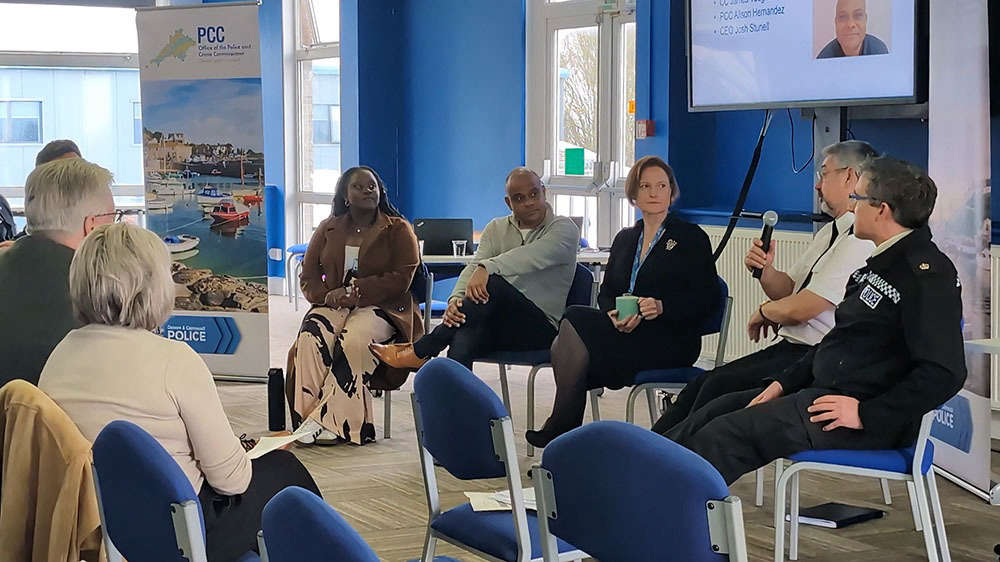
The challenges and complexities of policing protests have been highlighted during an event for Office of the Police and Crime Commissioner (OPCC) councillor advocates who connect with police to improve community safety, reporting, and communication.
The role of the police is to balance the right to protest peacefully with minimising the impact on others. In advance of confirmed protests, this can include engaging with organisers, local partners and businesses.
Last year, the force’s Ops Planning department risk assessed 1,498 ‘notifiable’ events which are not just protests but events such as football matches and festivals. After being assessed, 32 resulted in Public Order Public Safety Policing (POPS) command structures being put in place. Of those, 16 were protests. The vast majority of protests in Devon and Cornwall are peaceful with no arrests.
The distinction between lawful and criminal protests and definitions of hate crime were discussed during a seminar at police headquarters on March 4, hosted by the OPCC. Around 35 councillor advocates heard from key speakers including force Public Order Commander Superintendent Graham Thomas and Josh Stunell, CEO of bthechange CIC – which supports individuals and communities impacted by the criminal justice system and also helps ethnically diverse people build safer, fairer and more inclusive communities.
Last year, bthechange was commissioned by Plymouth City Council to do a piece of research understanding the cause of the riots which took place in the city in the summer of 2024. Alongside understanding the cause, the other objectives were to help Plymouth heel and foster a shared sense of community cohesion where everyone feels safe, valued and welcomed.
In the 12 months to November 2025, 2,437 hate crimes were recorded by Devon & Cornwall Police, up by 5.3 per cent when compared to the previous year. The majority of crimes were motivated by racial prejudice, followed by sexual orientation and disability.
The force’s Diverse Communities Team continues to provide specialist advice and support to victims of hate offences. Its Zero Tolerance to Hate Crime Campaign remains fundamental to their work, educating people about the effects and harm of hate crime, and providing reassurance to victims that offences will not be tolerated.
When it comes to protests, lawful gatherings are deemed to be those which include peaceful chanting, holding signs, public assembly and expressing political behaviour. However, protests become criminal when behaviour includes racial slurs, incitement to violence, assault or vandalism and stirring up hatred.
Police and Crime Commissioner Alison Hernandez and Chief Constable James Vaughan also spoke at the seminar. Both recognised the need distinguish between legitimate political expression and criminal activity.
The Commissioner said: “People from our minority communities are sometimes living in fear of being attacked or shouted at in the street. I think we’ve all got a job to do to help make our communities feel as safe as possible. I would like to thank all the councillors who attended the event. We talked about how, as elected representatives, we must be the brokers, the mediators, and the supporters during these turbulent times, when people are not feeling as safe as they should be. Making communities safe for all residents remains one of the key priorities in my Police and Crime Plan.”
To prevent serious disruption, police can use specific powers under Sections 12 and 14 of the Public Order Act. These set out legal conditions on organisers and participants around the routes, the length of time of any protest can take place, and the areas where respective groups must convene.
The councillor advocates seminar this week is one of four held each year. Each meeting is based on a different theme which focuses on one of the key priorities in the Police and Crime Plan – antisocial behaviour, drugs and alcohol, serious violence and theft.
Councillor advocates – unique to Devon and Cornwall – are volunteers from unitary, district and parish councils who have signed to improve communication between local councillors, the police and the Office of the Police and Crime Commissioner (OPCC).
For more details about the councillor advocate scheme, please click here Councillor Advocate Scheme – Your voice in policing
 Coronavirus memorial decisions are complex and regionally varied, new study shows
 Vital centre seeking new home to support its future
 Could there be more charged for car parks on Dartmoor in future?
 Scrutiny of potential changes to emergency worker scheme ramps up