
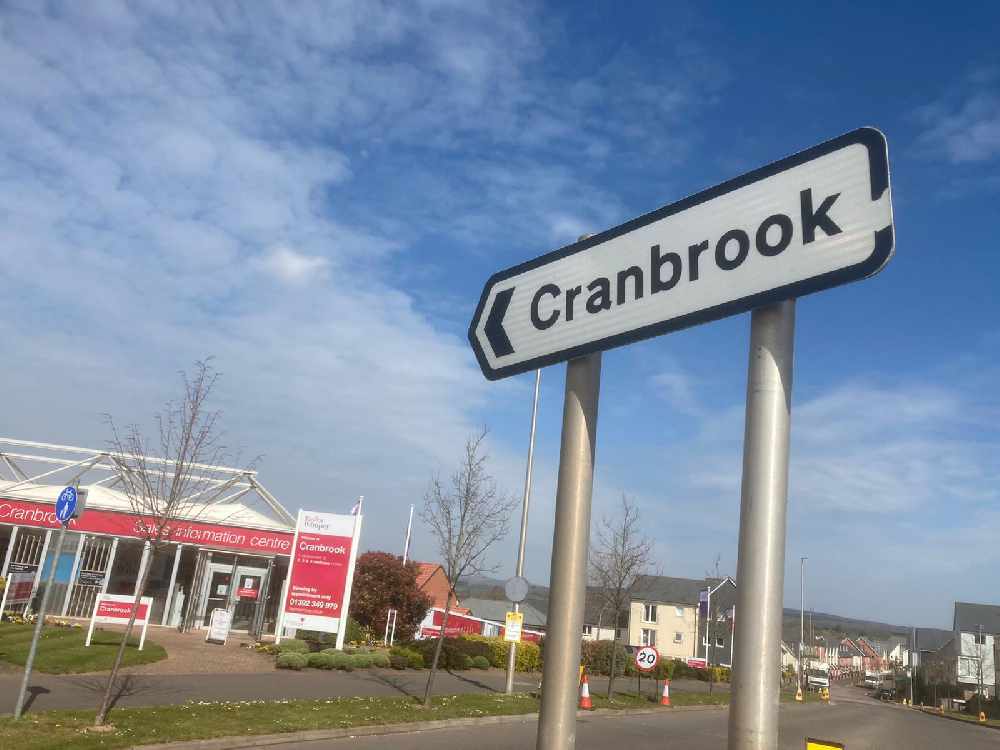
A grumble over gritting has emerged in Devon’s newest town, with claims that more needs to be done to help its residents.
The ice in Cranbrook has been coupled with a flurry of disgruntled comments by residents, some of whom claim certain roads and pavements have been left ungritted.
A professional dog walker in the town who runs Cranbrook PetCare said her car “spun a full circle on the biggest sheet of black ice”, on a post on Facebook.
“I was so lucky there were no other cars around and that I managed to steer into a kerb.”
She added she saw “people fall over” and given her job “can’t risk that myself” because of the need to stay in control of the dogs she walks.
“It’s a disgrace how dangerous it is,” she said, adding: “The developers have a lot to answer for.”
Others have said the police have called the black ice around Cranbrook and other areas some of the worst they’ve seen for some time, while there was also a report of a collision between a car and bus caused by ice, in which it is understood nobody was badly hurt.
Even the town’s MP, David Reed (Conservative), has fielded numerous complaints from residents and has even criticised a social media post from East Devon District Council that suggested some roads had been gritted by developers.
Mr Reed said he had received a “high volume of correspondence” including reports of falls and injuries.
“The core problem is that many of these routes are unadopted, meaning responsibility for gritting is unclear in practice, despite heavy use and ongoing freezing temperatures,” he said in a social media post earlier this week.
“The result is a situation where everyone can explain why it is someone else’s job, while local people are left at risk.”
East Devon District Council said it believed all main roads through Cranbrook were gritted “whether adopted or not”.
“Adopted roads have been gritted by Devon County Council, and unadopted roads have been gritted by developers and, more recently, Cranbrook Town Council.”
But Mr Reed questioned this, saying “are you sure” that unadopted roads had been gritted by developers.
Gritting only has to be done by a council that is responsible for roads in their area on so-called ‘adopted’ roads, which they are officially responsible for.
However, not every adopted road will automatically be gritted, as councils usually prioritise major routes, and those used by buses and emergency services.
Most of the roads in Cranbrook that have been left ungritted are ‘unadopted’ roads, meaning that they are still owned by the landowner or housing developer. As such, the council does not have a requirement to grit those.
Councillor Kevin Blakey (Independent, Cranbrook), a member of East Devon District Council, gritting had been taking place in the town but that complaints were mainly coming in from residents on side roads, and also about pavements.
“But I don’t know anywhere that grits side roads and pavements,” he said.
“Gritting is an extremely expensive operation.”
Cllr Blakey added that Devon County Council had a budget for gritting, but given financial pressures in various areas, was unlikely to be able to afford to expand its gritting operation significantly.
“The cash for that would have to come from council taxpayers, and I think people would be unhappy to pay a lot more money to pay for a solution to a problem that only lasts for a few days a year.”
Cllr Blakey suggested there were “one or two roads that have not been adopted where gritting could be appropriate”, but that when there were warnings of ice, it was important for people to take the necessary precautions.
A spokesperson for the consortium behind Cranbrook, that includes Taylor Wimpey and Persimmon, said: “We are sorry to hear about the challenges residents have been facing with the recent icy conditions.
“Developers in Cranbrook follow established local authority gritting policy and priorities, and do not treat roads that the council would not grit once they have been adopted.
“We recognise that this is a difficult situation for some residents and apologise for any inconvenience during this cold period.”
Responsibility for gritting roads in Devon falls to Devon County Council, and it has certain legal requirements under the Highways Act 1980.
The law states it is “under a duty to ensure, so far as is reasonably practicable, that safe passage along a highway is not endangered by snow or ice”.
The Local Government Association states UK councils are responsible for around 225,000 miles of road, but that it would cost “hundreds of millions of extra pounds to grit all roads”.
Cranbrook Town Council said while it did not have a statutory duty to undertake any gritting, it had taken “practical steps where we could”.
“This has included arranging and funding gritting on some unadopted roads along key routes, despite them not being in our ownership,” it said in a post on Facebook.
As a town council, our funding and staffing are limited, and we do not receive budget or equipment for county-level road gritting services or for purchasing and distributing grit bags at the moment.
“Any action taken by the town council is therefore discretionary and limited in scope.
We continue to raise residents’ concerns with Devon County Council.”
East Devon District Council said Cranbrook Town Council had been helping with arrangements for winter gritting and that even though it is “not the responsible authority” it had received one enquiry from a Cranbrook resident about the issue.
 Plea to protect Devon’s ‘lifeline’ libraries
 Smelly Exeter car park makeover postponed
 Your views wanted on nature in Exeter and how we can all support it
 Friction erupts as major development plan for Devon district rumbles on
 Your views needed on improving air quality in Exeter
 Matt Taylor returns to Exeter City
 Exeter stalker who left victim and housemates terrified is jailed
 Tell Ottery St Mary Town Council about your shopping habits!