
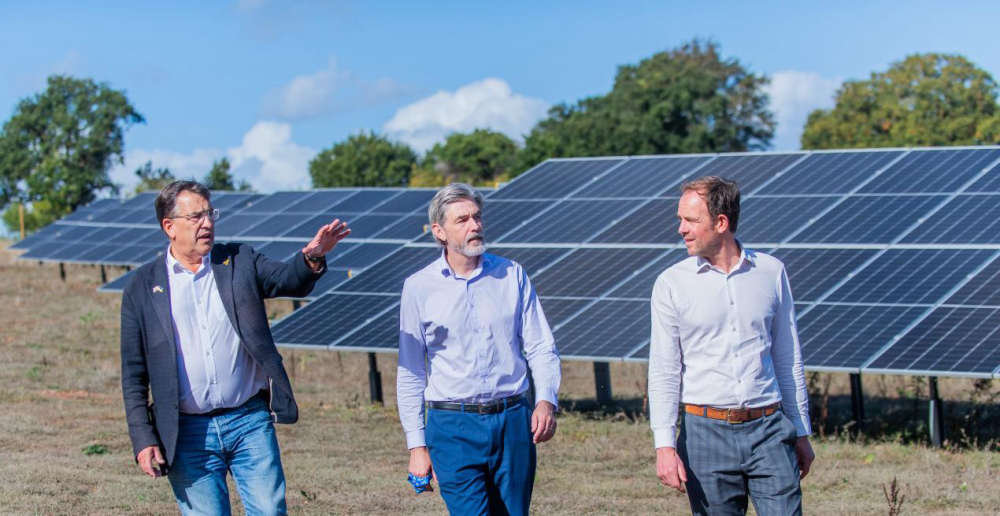
An NHS Trust in Devon is leading the UK’s clean energy charge following the switch on of a new 1.042 MW solar array and battery storage solution at Langdon Hospital in Dawlish, Devon.
Funded through a national clean energy grant – awarded to Devon Partnership NHS Trust by the Department for Energy Security, Net Zero and Great British Energy – the installation is forecast to meet over 60% of the hospital's annual electricity requirements.
Following its official switch on by Martin Wrigley, MP for Newton Abbott and Phill Mantay, Chief Executive at Devon Partnership NHS Trust, the ground-mounted solar-park and battery storage installation – designed and delivered by award-winning renewable energy specialist SunGift Solar – is now generating clean power which feeds directly into the hospital's operations, saving the Trust nearly £185,000 a year.
The project is expected to reduce carbon emissions by over 145 tonnes annually – equivalent to the carbon absorbed by approximately 6,500 trees – and is being viewed as a landmark scheme that could provide a blueprint for other NHS estates and healthcare providers across the UK.
By improving energy independence and long-term resilience, the project demonstrates how relatively small areas of land adjacent to hospitals can be transformed into significant sources of renewable power, helping major clinical sites become more self-sufficient.
More Power from Less Space
Central to the project's performance is the combination of high-efficiency JA Solar panels with Sigenergy’s hybrid inverters and SigenStack battery storage solution. Across approximately 3.5 acres of land, 1,628 solar panels have been installed using an innovative low carbon steel ground mount structure made by Solarport, which results in a 66% reduction in embodied CO₂ compared to conventional mounting frames.
Now, Langdon hospital is able to generate 1.042 MWp, significantly reducing the hospital's reliance on imported grid electricity, while increasing its ability to cope with peak periods of demand such as during heatwaves, when energy hungry air conditioning is in use.
Clean energy at scale
The solar park is expected to generate more than 1,068,000kWh of clean electricity each year – enough to power approximately 396 homes – and will play a key role in supporting NHS net zero ambitions while substantially reducing dependence on grid-supplied energy.
Intelligent Energy Storage leads to significant savings
The benefits of the PV system are maximised using onsite batteries. These enable Langdon Hospital to store excess solar energy generated during the day, which can then be drawn on overnight or during high-demand periods. This significantly reduces the hospital’s reliance on – and exposure to – peak demand grid prices. It fundamentally changes the way Langdon consumes electricity, saving the hospital nearly £185,000 a year, which can now be redirected into patient care. It also opens up the potential for energy exports to the grid, that could bring in thousands of pounds of income to the Trust.
Gabriel Wondrausch, Director at SunGift Solar, explains: "Through the use of commercial solar cells, coupled with one of the largest battery storage installations of its kind in the UK, we have transformed a relatively small parcel of land into a hugely valuable solar asset capable of delivering the majority of the hospital’s annual electricity needs. This is particularly exciting because it provides a model that can be replicated across NHS and healthcare estates throughout the UK."
Phill Mantay, Chief Executive at Devon Partnership NHS Trust, adds: "This investment not only supports our commitment to sustainability but also ensures significant cost savings that can be redirected into enhancing patient care. By embracing renewable energy, we are taking a crucial step towards a greener future for our organisation and the wider NHS community."
Martin Wrigley, MP for Newton Abbott commented: “It's been a pleasure to celebrate the opening of the new solar array at Langdon Hospital. This 1 megawatt array will generate almost enough electricity to make the site largely self-sufficient. Not only will it reduce the hospital's carbon footprint, it will also make the site more resilient. All in all, this is a great example of how investment in renewable energy can benefit both local services and the environment."
 Pub eyes expansion with virtual games and snooker rooms
 Calls for ‘fire summit’ amid rampant pressure on service
 Rail industry crackdown as trespassing criminals cause more than six and half days of delays on the South Western network in a year
 Communities invited to apply for new Devon library improvement grants
 Have Your Say on the Future of the Dawlish Aviary
 Heating oil support available as winter approaches
 Museum supporters demand answers over long closure
 Dissent over fire chief’s pay fails to block rise above £200k
 Cranbrook finally on cusp of proper town centre
 The Royal Devon urging people to get their #JabDone now before winter illnesses arrive
 Appeal for witnesses in hate crime investigation
 West Exe Students Raise Nearly £4,000 for Hospiscare
 Exeter Council tenants invited to help shape future housing services
 University climbs in Times Higher Education’s prestigious global rankings
 Entries for this year’s Exeter Sustainability Awards now open
 Campaigners eyeing viability of legal challenge over district-wide homes plan