
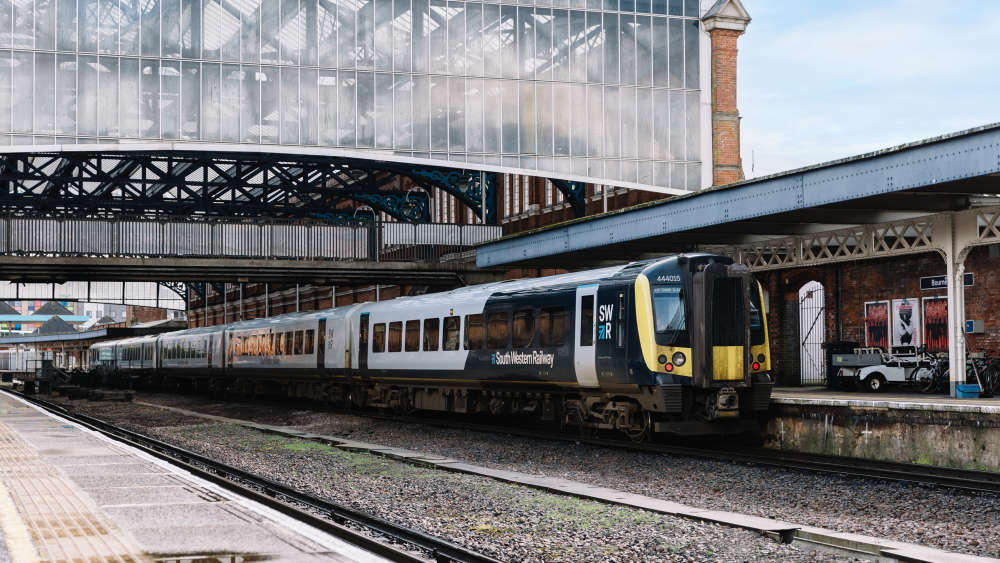
Work is ongoing across the South Western network to keep customers moving through tough weather conditions this autumn and winter.
Autumn is one of the most challenging seasons on the railway, and more storms, heavy rain and strong winds are expected to follow Storm Austen and Storm Boelo in the months ahead.
The storms caused significant disruption across the UK recently, and on the South Western network alone, and lots of trees fell on the railway between Friday 23 and Sunday 25 October.
Britain’s railway network is preparing for more incidents like these and the risks of flooding, high winds and landslips, in addition to the challenges that autumn always brings.
Across the industry, train operators have introduced autumn timetables, giving drivers more time to brake and accelerate during the leaf fall season, when wet weather and millions of leaves falling on the line reduces the grip between wheels and rails.
Key to improving that vital grip, or ‘rail adhesion’, is a fleet of ‘leaf-busting’ trains.
The trains use high-powered water jets to clear the slippery layer that is left on rails by leaves that have been crushed by passing trains. This residue can significantly reduce grip and leave conditions like black ice on roads, making it harder for trains to brake and accelerate.
Last year, the leaf-busters treated nearly 140,000 miles of track on the South Western network, the equivalent of more than five trips around the earth. Across Britain’s railway network, they will cover more than 1,000,000 miles this year.
Support for drivers and improvements for trains
Specialist cameras fitted to the leaf-busting trains can also assess rail conditions in real time, helping train drivers to anticipate difficult conditions. Experienced driver managers will also join newly qualified drivers in the cab to offer additional guidance during their first autumn journeys.
Drivers of South Western’s diesel fleet, which serves areas including Exeter, also benefit from an enhanced sanding system which has improved braking efficiency during autumn conditions.
In a UK-first, the system developed by Siemens has been retrofitted to South Western’s Class 158 and Class 159 trains, and it automatically assesses conditions and applies the correct amount of sand where it is needed.
Alongside seasonal preparations, South Western is investing in measures to protect the railway from increasingly frequent extreme weather, which can raise the risk of damage to railway infrastructure such as tracks, embankments, bridges and tunnels.
Network Rail is spending £2.6 billion on weather resilience projects up until the end of 2029, including South Western’s project to strengthen a cutting at Crewkerne in Somerset, the site of a landslip following torrential rain in 2023, that closed the line between Yeovil and Exeter for a week.
The six-month programme will improve the stability of the cutting, reduce the risk of soil movement, and help prevent further landslips.
 Library staff cut as employer aims to become ‘more resilient’
 Massive city centre development adapts to post-Covid habits
 “We’d be using our own homes if it wasn’t for the hub” – bigger, permanent base = bigger, permanent impact
 Celebrate Diwali in Exeter with fireworks, food and dancing
 Sidmouth Town Remembrance
 Parish boundary changes approved for Cranbrook and surrounding areas
 Double second-homes tax looks set to stay in East Devon
 Illegal e-bikes and e-scooters taken off the streets in Torquay
 Council urged to back under-fire lifeboat crews
 Booking open for Devon winter HAF programme
 Exeter set to honour the fallen at Remembrance Sunday Service
 Dartmoor parishes ‘can’t afford’ to take on parks and toilets
 Man charged with attempted murder, Torquay
 Amazon Scam Warning: Fraudsters Are Targeting UK Residents!
 Save water now to protect Devon’s most vulnerable residents
 How a forceful fungi could help tackle future bluetongue outbreaks