
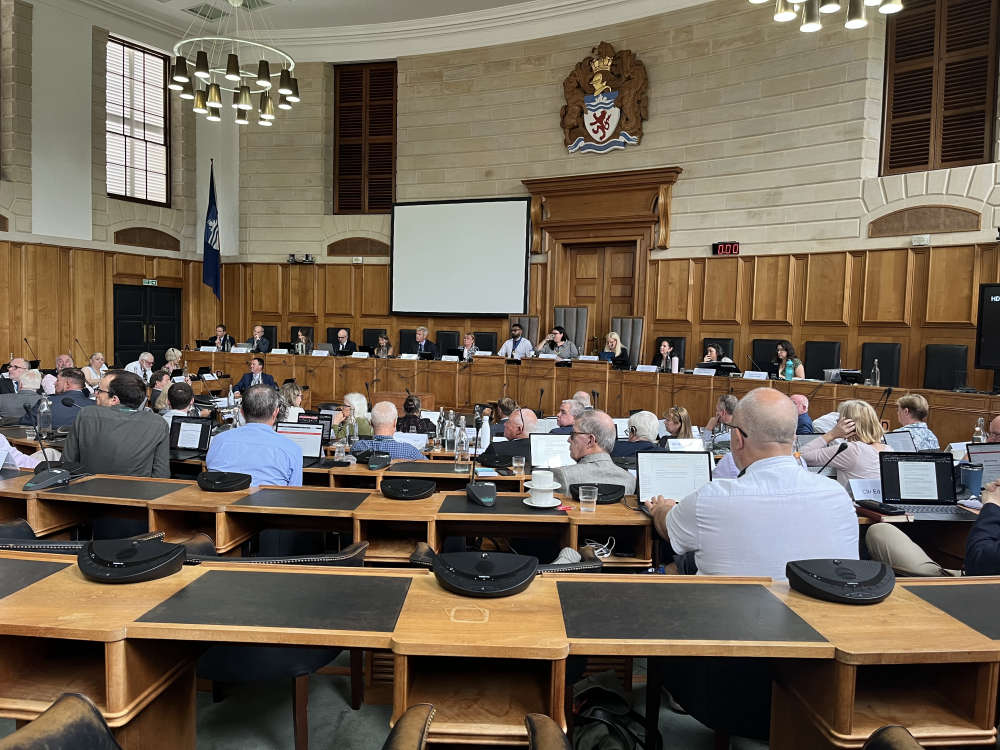
Members from across the political divide helped orchestrate a tactical vote that led to their council backing legal changes in planning policy but expressing huge anger at the new rules.
Forthcoming changes to planning law by the government have led to claims there will be a severe dilution of people power relating to planning applications in their neighbourhoods.
At present, planning officers – who are council employees rather than elected members – only tend to make decisions on small planning applications, such as house extensions, tree removals, or plans that tend to impact only that property.
Larger decisions linked to housing developments, even small ones, tend to be put before planning committees, which are populated by elected councillors.
But with forthcoming changes to the National Planning Policy Framework (NPPF), which provides the rules that councils must follow when it comes to planning, more decisions are likely to be ‘delegated’, or taken by officers, than planning committees.
This situation prompted members from across the political divide at Devon County Council’s full council meeting to criticise the government changes.
But Devon, which oversees planning applications linked to waste sites and minerals, such as quarries, is legally required to update its constitution to reflect the upcoming national legislative changes.
As such, councillors couldn’t vote not to update their rules for fear of being subject to legal action, so it was agreed that just a few members would vote for it, with the majority abstaining, and an additional recommendation to write to government to express the council’s displeasure.
“Devolution is about local decision-making, but with this it acutely withdraws the ability of local councils to engage fully in planning,” Councillor Alan Connett (LIberal Democrat, Exminster and Haldon) said.
He stated that officers were not elected, and that it was councillors that were contacted by the public about planning applications.
“I understand why we are here, and we have no choice [but to update our constitution], but it sticks in the gut and we ought to say the government needs to worry about the economy, international issues and other things and let us worry about decisions we are elected to make about housing, schools and economic development.”
Fellow Lib Dem, Councillor Frank Biederman (Fremington Rural) agreed the move by government was “just stripping the local voice” from planning.
“Labour has championed localism but this is a bulldozer’s charter for developers to do whatever they want.”
Councillor Dermot McGeough (Conservative, Northam) stated he was “dead against this”.
“To give central government this power is pure madness, and we can take a stand here,” he said.
After some debate and an adjournment to ensure how to take their action in a legally sound way, councillors agreed for just a small number to support the motion to update the constitution in line with the forthcoming changes to policy – because the council is essentially legally compelled to do so – but to do it in a way that showed disdain for the changes.
This led to just seven votes for it, two against, with the rest of the 60-strong chamber abstaining.
Councillor Neil Stevens (Reform UK, Alphington & Cowick), seconded the amendment by council leader Councillor Julian Brazil (Liberal Democrat, Kingsbridge) to write to the government expressing “our dismay at legislation that is an affront to democracy and which removes local knowledge and experience from the planning process”.
Councillor Caroline Leaver (Liberal Democrat, Barnstaple South), said she had “never seen such a meeting of minds” in the chamber across the parties.
“The government’s rhetoric is about power closer to communities but this is the opposite,” she said.
Council officers did state that under the new rules, while officers would be able to make more planning decisions by themselves, there would be a triage system, and therefore still a way for applications to be put before planning committees.
While the changes were deemed controversial at County Hall, they could be more significant for district councils, which have the responsibility for approving or rejecting housing schemes.
 Devastating fires ‘still a threat’ for Dartmoor
 Cheer and challenges as Devon’s tourism sector navigates summer extremes
 Lloyds cheque deposit service returns to Post Offices across Devon
 Devon holiday park eyes expanded opening dates
 Man sentenced for assault in Ottery St Mary town centre
 Exeter City Community Trust secures major grant to tackle homelessness
 Know Your Numbers! Week marks successful one year anniversary of library blood pressure monitor loan scheme
 University of Exeter welcomes first students to Joint Education Institute in China
 Surveys mark next step for proposed Boniface Trail
 Learn Devon launches its latest free adult education courses
 ‘Show some bottle’ call over Exeter water stations
 Police appeal for information about wanted Dawlish man
 ‘Iconic’ Exeter city centre bridge won’t be replaced
 The Royal Devon’s 2025 Adult Inpatient survey results consistent with national average, praise for respectful and compassionate care
 Overnight closures planned on the A380 between Eagle Farm and Splatford Split
 Backing for legal challenge to government’s council shake-up