
The land a Devon youth football team was blocked from moving to is included in a strategy that identifies suitable locations for outdoor sports.
Honiton Youth Football Club had submitted plans to move to land near Tower Road because their current pitch lacks any facilities – including access to water – and their lease has expired.
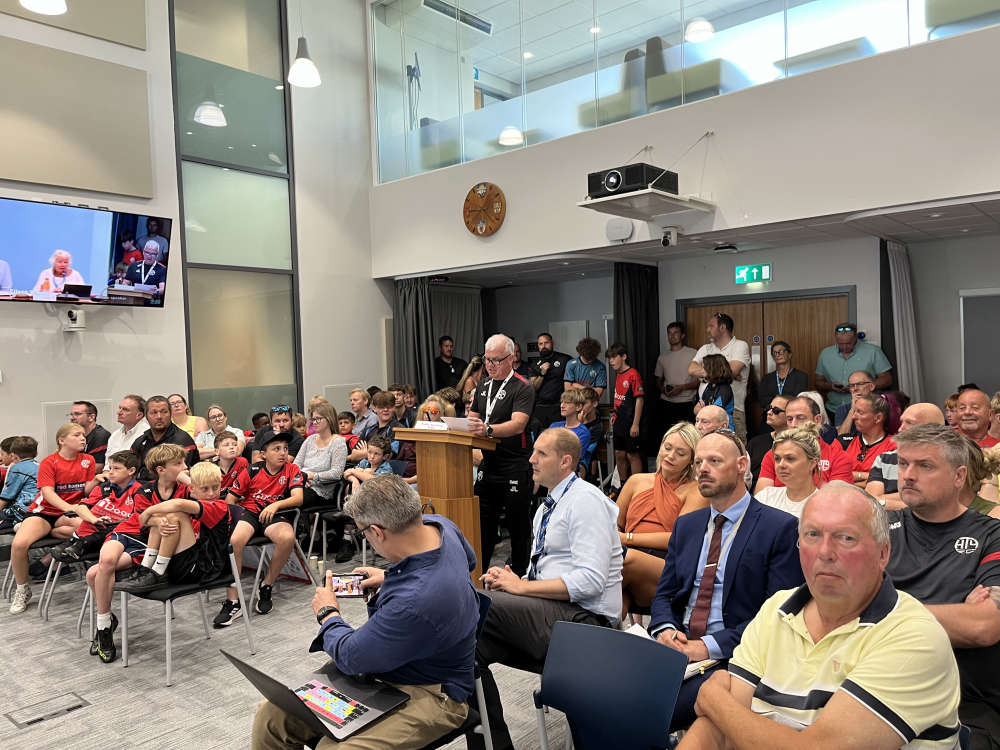
The club packed out the public gallery of a planning meeting earlier this month, but in spite of their efforts, their bid was defeated partly because of fears about the potential danger of stray golf balls from the neighbouring Honiton Golf Club.
However, it has now emerged that the site the club had hoped to move to is included in an outdoor sports strategy created by East Devon District Council, whose planning committee rejected the plans.
The Playing Pitch and Outdoor Sports Strategy (PPOSS) includes land at Tower Hill, which includes the area of land near Tower Road that Honiton Youth Football Club had been eyeing.
It does state that such an allocation is subject to planning permission being granted, though, meaning its designation as being suitable for sports use does not mean the usual planning hurdles are removed.
A spokesperson for East Devon District Council said: “Identifying the site in principle through our strategy does not automatically mean that a specific proposal for that site is acceptable in planning terms.
“The proposed strategy is aspirational and has been prepared with input from Sport England and the relevant national governing bodies, using their established methodology for playing pitch strategies.”
The spokesperson added it had “seen and considered” the relevant health and safety information relating to the golf club’s current operations, including risk assessments covering the risk of stray golf balls.
“The golf club, as an employer, has a legal responsibility to assess risks arising from its activities and put suitable controls in place to protect employees and other people,” the spokesperson said.
“The council is satisfied that the club has appropriate risk assessments in place for its current use, including an independent assessment covering higher risk holes.
“Any additional or increased risk linked to planning applications is a matter for the planning process.”
Planning officers had at the start of the year recommended the youth football club’s plans be approved, but their guidance changed because of a planning rule that states applicants need to provide “suitable mitigation” to show their plans don’t impede existing businesses.
In this case, the risk of wayward golf balls contributed to planning officers proposing a rejection of the plans, alongside concerns about the impact of the site on National Landscape land and worries about the loss of a hedgerow that would need to be compensated for.
The council said without a ball strike survey, it could not suitably assess the potential risk of wayward golf balls, and because it couldn’t quantify that risk, it couldn’t properly assess it.
But the youth football club said its legal advice had been not to conduct a ball strike survey, because doing so could be deemed tantamount to accepting responsibility for the issue and for trying to mitigate against it.
The club stressed that its current facilities were inadequate, with no toilets, changing rooms, or running water, with poor access that would prevent spectators in wheelchairs watching their children or grandchildren playing.
After the decision, the club’s chairman, John Leisk, said he was “devastated”, but at that point had not decided whether the club would appeal the decision or not.
Speaking after the decision, the planning committee chair, Councillor Eileen Wragg (Liberal Democrat, Exmouth Town), said the decision was taken because of the element of risk to the public and young people.
“We gave it a lot of thought and there was support for approval but we believed that the risk [presented by potential wayward golf balls] outweighed that,” she said.
Cllr Wragg added that if the committee had approved it, it could have “gone to judicial review which would cost a lot of money”.
“The committee offered to defer the decision until an assessment had been carried out but the football club refused point blank,” she added”
Her deputy, Councillor Steve Hunt (Liberal Democrat, Seaton), said the outcome could have been different if the club agreed to conduct a ball strike assessment.
“I cannot understand [their legal advice] as our legal advice is telling us that the football club is the agent of change.”
Parents who attended the meeting with their children were aghast at the result, with some saying that a wayward golf ball assessment already existed and had put it as low, with others fearing the potential demise of youth football in Honiton if the club is forced to move from its existing base before it has a new one.
 Scam letters requesting payment
 Matford Brook Academy Expands Facilities for New School Year
 County Council backs renewed support for Devon farmers hit by bluetongue
 Get vaccinated and don’t visit patients if unwell, health leaders urge as flu hits local hospitals
 Severe drought declared as reservoir levels fall
 All Souls Day Festival returns to Exeter
 Starcross family raise £10k for Hospital ICU Garden Appeal
 25 months in jail for woman who smuggled Thai cannabis
 Homes plan lodged for former Exeter leisure centre
 A Crowdfunding campaign has launched to raise some of the funds needed to build a permanent community “village green by the sea” in Exmouth.
 Fire Service issues enforcement notice for fire safety breaches at Torbay hospital
 Unsung heroes’ who keep Exeter looking good honoured at awards
 County Council backs plan to help young people build a future in Devon
 Householders urged to fight fly-tipping by choosing reputable removers
 Multi-million pound funding boost to Devon’s road’s
 ‘Frustration’ as £5million Newton Abbot market stays shut