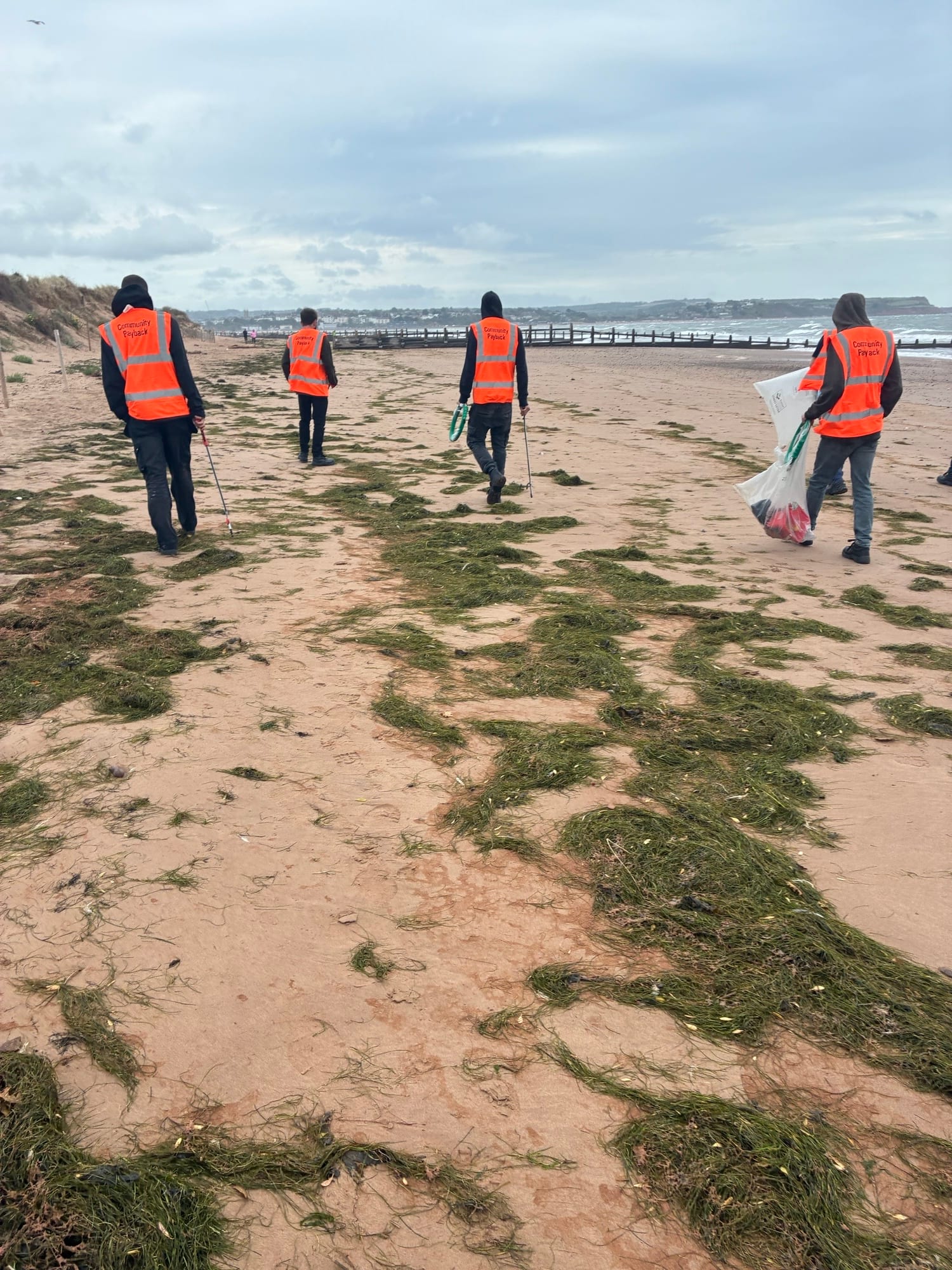
Offenders serving community sentences have helped remove harmful waste from popular Devon beaches as part of a national event.
Supervised community payback teams were put to work during the Marine Conservation Society’s national Great British Beach Clean event, and worked on Paignton’s Goodrington Sands as well as Dawlish Warren.
The collected bags of rubbish, including plastic cutlery, food packaging, and discarded buckets and spades.
The Community Payback scheme sees the offenders provide unpaid work as part of requirements ordered by courts as part of a community sentence.
Lizzie Price, beachwatch manager at the Marine Conservation Society, said: “We really value offenders playing an active role in protecting our seas and communities.
“Clearing litter from our beaches is a practical way to contribute to both the local environment and wider conservation efforts and helps to gather important information on what’s washing up on our shores.
“From sewage-related items such as wet wipes to plastic bottles, recording each piece of litter helps us better understand ocean pollution and supports us in campaigning for cleaner seas and a healthier planet.”
Ms Price added that litter left on beaches can have a serious impact on wildlife and coastal environments, with plastic items breaking down into microplastics and causing long-lasting damage to coastal environments and threatening wildlife.
The community work initiative has been championed by the minister for prisons, probation and reducing reoffending, Catherine McKinnell.
She said as well as the work undertaken, it helps offenders get into a working routine and gain practical skills.
“Projects like this ensure that offenders give back to the communities they have harmed through meaningful work that delivers a positive impact locally,” she said.
“Through doing the unpaid work they are developing skills, work experience and positive habits that can help them secure employment and reduce reoffending.
“Delivering punishment that also works to cut crime will make our streets safer and better protect the public.”
Community sentences are made up of 14 possible requirements that those convicted of offences are expected to meet, which include restrictions such as unpaid work they must carry out in the community, exclusion zones, electronically monitored curfews, and treatment programmes.
If not met, offenders risk being sent back to court.
The expansion of punishments outside of prison, like community sentences, is part of wider landmark sentencing reforms implemented by the government as it tries to make sure prisons don’t become full.
The Government has said it is building 14,000 prison places and investing £700 million to strengthen the probation service.
The plight of one of the nation’s rarest bats has been raised as a possible issue by campaigners opposing a potential monster housing allocation in Exmouth.
Funding shortfalls and falling school rolls are putting teachers and leaders’ jobs at risk and threatening children’s education in the South West, a leading union is warning ahead of the Budget.
The Royal National Lifeboat Institution (RNLI) is reminding those visiting the coast to be aware of the dangers as Storm Austen is expected to bring strong winds and heavy rain to the South West from late Thursday into Friday.
Natural flood defences such as ponds, ‘leaky’ wooden dams and trees can significantly reduce the risk of Devon’s most vulnerable communities from flooding, researchers have found.
South West Water is urging customers to check their toilets for hidden leaks as the region enters a critical phase of an exceptionally prolonged drought.
Exeter’s Community Safety Team is making a real difference for visitors and businesses in the city centre, helping to tackle anti-social behaviour and ensuring everyone can enjoy a safe, vibrant and welcoming environment.
Exmouth Community College’s Sixth Form Football Academy has welcomed its first female players this season, expanding the programme to girls following strong demand for its boys’ programme, which is now full.
A new report has found no evidence that councils serving more than 500,000 people are automatically more efficient, financially sustainable or effective.
A plan to turn a former care home in Newton Abbot into 18 homes for ‘young, working professionals’ has been given the go-ahead despite concerns over parking and potential anti-social behaviour.

 Dispute over rare bat‘s presence adds bite to Exmouth’s possible 700-homes site
 MPs demand action over ‘shameful’ Royal Mail deliveries
 Fire service opts to restrict water usage amid severe drought hitting Devon
 More than 4 in 10 South West school leaders say their schools face redundancies or restructuring
 RNLI urges public to stay safe in the South West during Storm Austen
 Natural flood defences shown to protect flood-prone Devon communities.
 South West Water urges customers to check for leaking toilets as drought reaches critical phase
 One week left to have your say on Devon's mayoral plans
 Storm Austen: Check before you travel as strong winds impact rail services in Devon and Cornwall on Friday
 Revised plans to repair Exeter’s Trews Weir revealed
 Road users urged to take care as Storm Austen approaches
 Councillors on patrol to see how Exeter is being kept safe and welcoming
 Exmouth Sixth Form Football Academy Expands to Girls
 New research finds no evidence that bigger councils deliver better services
 Go-ahead for Newton Abbot HMO despite concerns
 Get snapping now and capture prizes in tree photo competition