
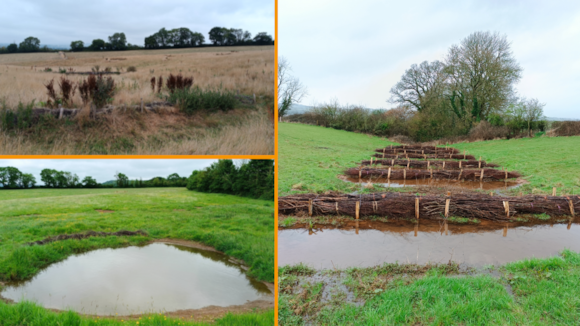
Natural flood defences such as ponds, ‘leaky’ wooden dams and trees can significantly reduce the risk of Devon’s most vulnerable communities from flooding, researchers have found.
A University of Exeter team looked at how well natural flood measures performed during 662 storms across five Devon river valleys.
They concluded that natural flood management is a vital part of the range of measures used to help protect at risk communities.
The research is increasingly important as climate change is expected to increase the frequency and intensity of some extreme weather events.
They found that natural measures can slow fast-flowing water and store it temporarily before it reaches communities downstream.
Holding water higher up a catchment, the area of land from which rain drains into the same river or stream, can stop large volumes arriving downstream at once.
The work, funded by the Department for Environment, Food & Rural Affairs, was commissioned through the Devon Resilience Innovation Project (DRIP), led by Devon County Council with its partners to test new ways of making communities more resilient to flooding.
Researchers studied sites at Stokeinteignhead, Tattiscombe, Exton and two catchments near Ottery St Mary.
Depending on the site, the measures reduced peak flow, the largest amount of water flowing downstream at one time by between 30 per cent and 62 per cent.
Combinations of ponds, leaky barriers, tree planting and other natural measures were associated with measurable reductions in peak river flows.
The strongest result was near Ottery St Mary, where peak flow fell by 62 per cent compared with a similar nearby area without the natural flood measures.
There, 26 log jams, 15 ponds, tree planting and changes to land management delayed the surge in the river.
On average across the five catchments, it took more than an hour for rivers to reach peak flow.
At Exton, leaky dams, tree planting, a pond and land-management changes reduced peak flow by 53 per cent.
At Stokeinteignhead, leaky dams, ponds and a scrape - a shallow hollow dug to collect and temporarily hold rainwater - cut peak flow by half.
A combination of measures also worked at Tattiscombe. Reconnecting the floodplain, adding large pieces of wood and leaky dams to streams, planting trees and creating scrapes and ponds reduced peak flows and on average delayed them by one hour.
Researchers found that the best results generally came from combining measures and placing them where they could intercept water during heavy rain.
They cautioned that the effect varies with the landscape, rainfall and how wet the ground is beforehand.
Mehdi Bagheri-Gavkosh, PhD Researcher, Centre for Resilience in Environment, Water and Waste (CREWW), University of Exeter said: “One of the most rewarding aspects of this research has been seeing the evidence emerge from real rainfall events across small, rapidly responding catchments in Devon. By monitoring hundreds of events, we found that carefully combined natural flood management measures can reduce peak river flows and delay the response of streams to heavy rainfall.
“These findings show the real potential of working with nature to help manage flood risk, while also reminding us that every catchment is different, and that long-term monitoring is essential to understanding what works best and where.”
Councillor Jacqi Hodgson, Devon County Council Cabinet Member for climate change and biodiversity, said:
“There isn’t one simple answer to flooding, but these results show that a combination of relatively small measures across a catchment can add up and make a real difference, helping to hold water back, reducing the peak flow and the volume of water reaching streets and properties downstream. Upstream measures give communities downstream more time to react to storms.
“Natural flood management is not a replacement for conventional defences. Engineered measures such as flood walls, embankments and improved drainage still have an important role, but the study shows that working with nature in the landscape can complement engineered defences and provide another layer of protection.
“The important lesson is that we need the right measures in the right places, and that local people can assist with this alongside the other ways we prepare for and manage flood risk across Devon.”
The full study can be found here: Hydrological effectiveness of multiple natural flood management interventions in rapid responses catchments - ScienceDirect
 South West Water urges customers to check for leaking toilets as drought reaches critical phase
 One week left to have your say on Devon's mayoral plans
 Storm Austen: Check before you travel as strong winds impact rail services in Devon and Cornwall on Friday
 Revised plans to repair Exeter’s Trews Weir revealed
 Road users urged to take care as Storm Austen approaches
 Councillors on patrol to see how Exeter is being kept safe and welcoming
 Exmouth Sixth Form Football Academy Expands to Girls
 New research finds no evidence that bigger councils deliver better services
 Go-ahead for Newton Abbot HMO despite concerns
 Get snapping now and capture prizes in tree photo competition
 Devon MPs issue air ambulance funding plea to chancellor
 Keeping the region’s water flowing as the drought reaches a critical phase
 Exeter teams reach national final of student innovation competition
 Appeal following theft of pregnant heifer, East Devon
 Are you or someone you know eligible to join the Priority Services Register?
 Every day is everything: Adopt South West celebrates the moments that make family life