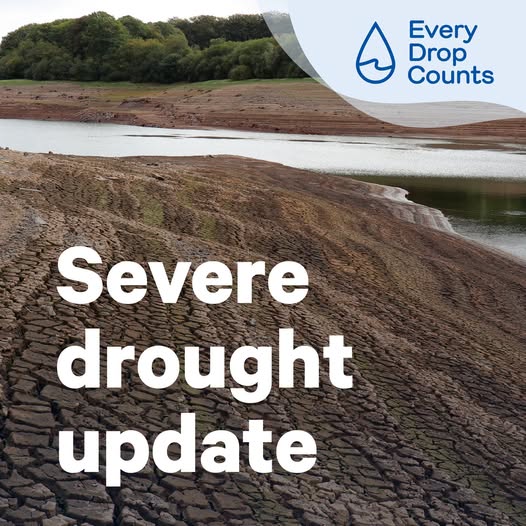
The South West has entered a critical phase of an exceptionally prolonged drought. Recent rainfall is welcome, but we have not seen nearly as much as was previously forecast for October, and certainly not enough to remove the pressure on water supplies.
Following the hottest summer on record, drought conditions continue across much of England, and the Environment Agency announced that parts of Cornwall, Devon and West Dorset have entered Severe Drought status.
That is a stark reminder of the water resources position we are facing.
While South West Water continue to do everything they can to protect supplies, they need households and businesses to play their part too. Every litre of water saved now helps preserve the resources we have available while we wait for river flows and reservoir levels to recover. Nobody cannot control how much rain falls, but we can all help make the water we have last longer.
In some parts of the region, water stored in reservoirs has been supporting public water supplies since as early as March, and we have particularly low storage in a number of reservoirs.
While these reservoirs are currently in the most critical position, storage across the region is dropping and needs all of our focus to protect customer supplies. Our rivers are still not flowing strongly enough to allow us to take the water we need to meet customer demand, so we remain reliant on stored water in our reservoirs. And that water is limited.
Many people understandably think a drought is over once it starts raining. In reality, recovery takes much longer. After such a prolonged dry period, rainfall first has to replenish dry soils and the wider environment before rivers return to expected levels. Only then can reservoirs begin to recover properly.
The recent rain is helping, but it has not undone months of exceptionally dry weather.
The immediate challenge is whether we can reduce demand and preserve enough stored water to maintain supplies until river flows recover. Taking action now gives us the best opportunity to protect supplies and reduce the risk of further restrictions or interruptions to supply while water resources remain under pressure.
We have a responsibility to do our part
Customers should expect South West Water to prepare for drought, manage supplies carefully and take action where public water supplies are under pressure. That is why a hosepipe ban remains in place across the South West for all customers. The Company recognises these restrictions are inconvenient, and thank customers for the support they have shown so far. They are helping to reduce demand and protect storage levels.
They have also applied for a Non-Essential Use Ban drought order for the parts of Devon and West Dorset now in Severe Drought because further reductions in demand may be needed to protect remaining supplies. The purpose of applying is to help preserve water for essential public supply.
Alongside these measures, we continue to invest significantly in the water infrastructure. This includes strengthening and connecting our network, improving reservoirs and treatment works, developing new water resources, increasing our ability to move water around the region, and investing in demand management and smart metering.
They also fixing more leaks than ever before, and our teams have worked around the clock to fix over 27,000 leaks in the last 12 months.
You cannot change the weather or the geography of the South West, but we can continue building a more resilient water system, and that is exactly what our investment programme is designed to do.
We need to protect the water we have now
We also need customers to help. We recognise that hosepipes are naturally being used less now we’re out of summer and that means the biggest difference customers can make now is through the everyday changes they make inside their homes and businesses.
For businesses and households alike, we want to go further than simply asking people to use less water. Taking shorter showers, turning off the tap while brushing your teeth, only running washing machines and dishwashers when they are full, and fixing dripping taps and leaking toilets can all make a real difference.
Individually, these actions may seem small. Collectively, they can save millions of litres of vital water. Reducing demand now helps preserve the water remaining in storage and gives rivers more time to recover.
Why are different companies in different positions?
Drought does not affect every part of the country or every water company in the same way. The South West has a large and complex network spread across a long peninsula, serving communities across a wide geographic area with significant seasonal increases in demand.
Our water supply also differs from many other regions. Some water companies rely heavily on groundwater stored naturally in underground aquifers. Across much of the South West, we are more dependent on surface water, particularly rivers and reservoirs. These sources can come under significant pressure during prolonged dry weather and take longer to recover once drought conditions develop.
Water also cannot simply be moved without limit from an area where resources are healthier to an area under greater pressure. Geography, pipeline capacity, treatment capability and network configuration all affect how much water can be moved and where.
That is why the impact of drought, and the speed of recovery, can vary between regions, and why not all parts of the country, or even the region, are now in Severe Drought.
We are reviewing the position daily and will continue to take action through restrictions, investment, careful management of supplies and preparations for additional drought measures.
Thank you to everyone who has already reduced their water use and supported the restrictions in place across the South West. Those efforts are helping, but as the drought enters a more critical phase, reducing demand remains as important as ever.
We are asking every household and business to make saving water part of their daily routine. This is not just about complying with the restrictions already in place; it is about actively reducing unnecessary water use wherever possible, every day.
The action we take now matters. Every litre saved helps us manage the resources available while we wait for our rivers and reservoirs to recover.
 Go-ahead for Newton Abbot HMO despite concerns
 Get snapping now and capture prizes in tree photo competition
 Devon MPs issue air ambulance funding plea to chancellor
 Exeter teams reach national final of student innovation competition
 Appeal following theft of pregnant heifer, East Devon
 Are you or someone you know eligible to join the Priority Services Register?
 Every day is everything: Adopt South West celebrates the moments that make family life
 New initiative aims to boost digital confidence across Devon
 Resident blocked from using ‘sustainable travel’ vouchers on train tickets
 South West Water clears more than 5,500 avoidable sewer blockages in a year as it urges customers to only flush the three P’s
 Exeter’s NIHR Policy Research Unit in dementia granted £2 million extension
 Specials thanked for the difference they make every day
 Exeter’s RAMM acquires beautiful collection by British Modernist artists
 Farm Fuel Security
 Devon blood bike charity revs up its volunteer plea
 Tension dials up in latest chapter over future of librarians