
A new report has found no evidence that councils serving more than 500,000 people are automatically more efficient, financially sustainable or effective.
The findings come as the Government reviews local government reorganisation (LGR) proposals across England.
The report, Bigger Doesn't Mean Better, says future council structures should reflect the needs of places and communities rather than a single population target.
Commissioned by a coalition of English cities, including Exeter, the report examined council spending, care costs, inspection outcomes and financial resilience.
It found that population size alone does not determine service quality, cost or organisational performance.
The report urges ministers to assess each proposal on its merits, including local conditions, service models and its ability to support growth, housing, devolution and prevention.
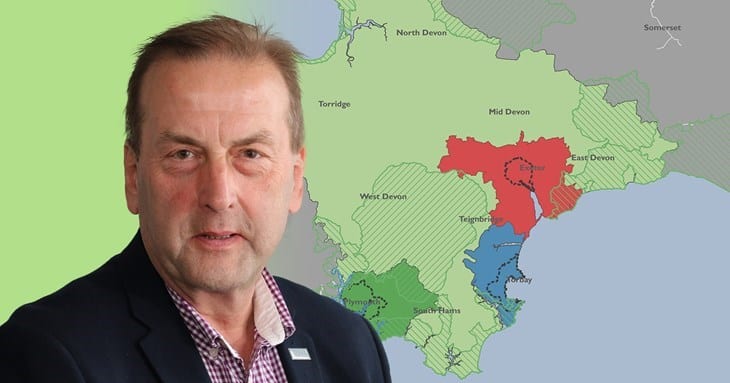
In July the Government backed a joint submission by Exeter and Plymouth for the creation of four new unitary councils in Devon.
Under the plan, Exeter combines with 49 surrounding parishes from Teignbridge, East Devon and Mid Devon, leading to a population of around 260,000.
In September the government announced it wanted to reflect on and pause its nationwide LGR programme and is expected to make further announcements shortly.
The County Councils Network has called for the Government to return to criteria calling for new unitary councils to have populations of at least 500,000.
But key findings in the new report include:
- No evidence supports using 500,000 residents as the point at which a council becomes sustainable or effective
- Larger councils do not consistently deliver lower costs, better services or stronger outcome
- Leadership, organisational design, service models, partnerships and community relationships have more influence on performance than size alone. Councils should reflect the needs of their urban, coastal or rural communities.
Cllr Phil Bialyk, Leader of Exeter City Council, said: “As the Government reviews local government reorganisation proposals across England, this report provides an important contribution to the debate about what makes an effective council.
“For too long the discussion has been reduced to a simple argument that bigger councils must be better councils. This research shows the reality is far more complex.
“The evidence does not support the idea that crossing an arbitrary population threshold automatically leads to better services, lower costs or stronger financial resilience. What matters is how councils are designed, how they work with residents and partners, and whether they are focused on delivering the outcomes local people need.”
He added: “LGR and not simply about creating larger councils - it is about creating councils that can drive economic growth, support new homes, strengthen devolution and deliver high-quality public services.
“For cities like Exeter, local leadership, strong accountability and an understanding of local communities is fundamental to achieving those goals. Decisions about the future of local government should be based on what will best serve residents, businesses and places, not population figures.”
The report highlights that Government criteria describes 500,000 residents as a “guiding principle”, not a mandatory threshold. A 500,000 pass/fail test would overlook economic geography, service quality, local identity and devolution, and some major cities would also fall below it.
The report urges ministers to consider economic geography, service quality, local identity, devolution, financial resilience and neighbourhood empowerment when assessing proposals.
It also says reorganisation could help councils support economic growth, unlock housing, strengthen devolution and redesign services around prevention and local need — but only if new institutions are designed around those goals rather than scale alone.
The report, by Inner Circle, was jointly commissioned by a coalition of English cities - Exeter, Oxford, Cambridge, Lincoln, Norwich and Ipswich.
 Storm Austen: Check before you travel as strong winds impact rail services in Devon and Cornwall on Friday
 Revised plans to repair Exeter’s Trews Weir revealed
 Road users urged to take care as Storm Austen approaches
 Councillors on patrol to see how Exeter is being kept safe and welcoming
 Exmouth Sixth Form Football Academy Expands to Girls
 Go-ahead for Newton Abbot HMO despite concerns
 Get snapping now and capture prizes in tree photo competition
 Devon MPs issue air ambulance funding plea to chancellor
 Keeping the region’s water flowing as the drought reaches a critical phase
 Exeter teams reach national final of student innovation competition
 Appeal following theft of pregnant heifer, East Devon
 Are you or someone you know eligible to join the Priority Services Register?
 Every day is everything: Adopt South West celebrates the moments that make family life
 New initiative aims to boost digital confidence across Devon
 Resident blocked from using ‘sustainable travel’ vouchers on train tickets
 South West Water clears more than 5,500 avoidable sewer blockages in a year as it urges customers to only flush the three P’s