
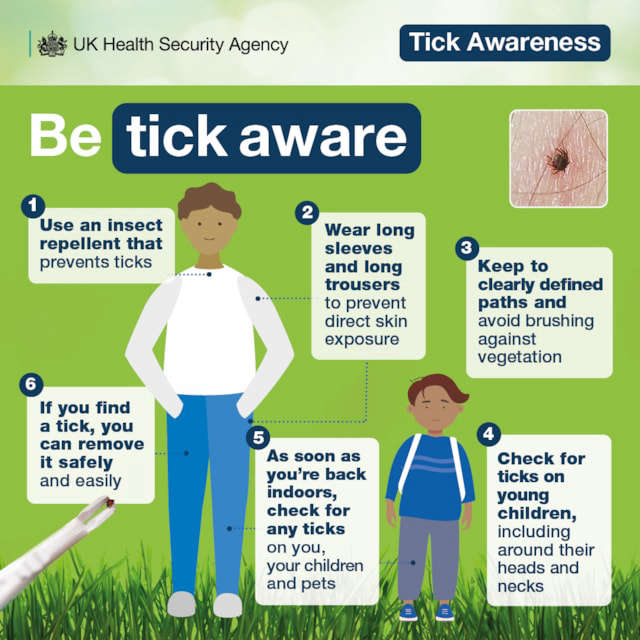
Residents living in or people visiting the South West who are planning to spend time outdoors this summer are being urged to be tick-aware
UK Health Security Agency (UKHSA) South West is urging people in the region to take precautions against tick bites this summer, following the publication of the first annual One Health Vector-Borne Disease Surveillance Report.
The report, published with the Department for Environment, Food and Rural Affairs (Defra) and the Animal and Plant Health Agency (APHA), brings together human, animal and vector data from 2025 to give a comprehensive picture of the changing risk of vector-borne diseases in England.
The South West is one of the highest-risk regions in England for tick bites and tick-borne disease. The report confirms that the region recorded 281 laboratory-confirmed acute Lyme disease cases in 2025, the second-highest of any region in England. Over the past five years, the South West has consistently been among the regions reporting the highest annual cases of the disease.
The region also has the highest rates of tick bite reports in England and contributes a significant proportion to the national Tick Surveillance Scheme each year since 2013. Tick activity typically increases in late spring, peaking in June.
Across England, Lyme disease remains the most common locally acquired vector-borne infection, with 1,168 laboratory-confirmed acute cases reported in 2025, higher than the 959 cases recorded in 2024.
Tick bites can occur year-round, but people spending time outdoors in wooded areas, grassland and heathland, habitats common across the South West, are at greatest risk. Anyone who has been bitten by a tick should remove it as soon as possible using a tick removal device or fine-tipped tweezers, and be alert to symptoms such as a spreading rash, flu-like illness or fatigue in the weeks that follow.
Jennifer Taylor, Consultant in Health Protection at UKHSA South West, said:
"The South West is consistently one of the regions with the highest rates of tick bites and tick-borne disease in England, and that pattern continued in 2025. Our beautiful landscapes are part of what makes this region special, but they are also habitats where ticks thrive.
“We want people to continue enjoying the outdoors this summer, but to take simple precautions: cover up where you can, check yourself and your children for ticks after being outside, and remove any ticks promptly. If you develop symptoms after a tick bite, please seek medical advice."
How to reduce your risk
- Cover your skin when walking in areas where ticks may be present, such as long grass, bracken and woodland
- Use insect repellent on exposed skin
- Check for ticks on your skin and clothing during and after being outdoors, including on children and pets
- Remove any ticks as soon as possible using a tick removal device or fine-tipped tweezers
- Seek medical advice if you develop a rash, fever or flu-like symptoms after a tick bite
 Scam letters requesting payment
 Matford Brook Academy Expands Facilities for New School Year
 County Council backs renewed support for Devon farmers hit by bluetongue
 Get vaccinated and don’t visit patients if unwell, health leaders urge as flu hits local hospitals
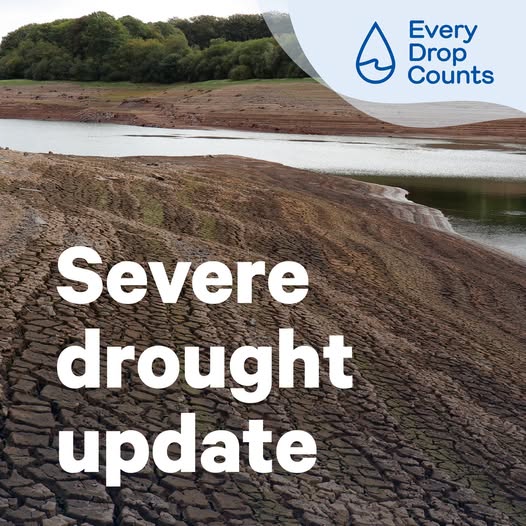 Severe drought declared as reservoir levels fall
 All Souls Day Festival returns to Exeter
 Starcross family raise £10k for Hospital ICU Garden Appeal
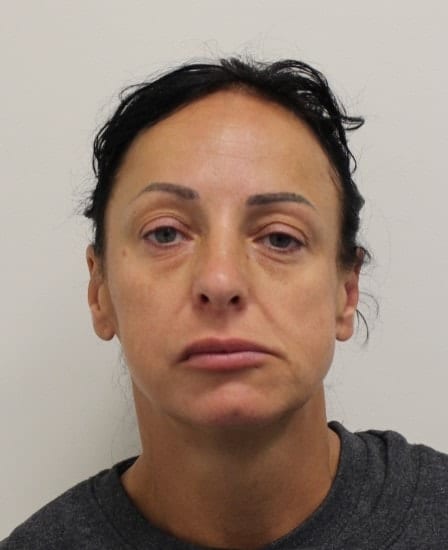 25 months in jail for woman who smuggled Thai cannabis
 Homes plan lodged for former Exeter leisure centre
 A Crowdfunding campaign has launched to raise some of the funds needed to build a permanent community “village green by the sea” in Exmouth.
 Fire Service issues enforcement notice for fire safety breaches at Torbay hospital
 Unsung heroes’ who keep Exeter looking good honoured at awards
 County Council backs plan to help young people build a future in Devon
 Householders urged to fight fly-tipping by choosing reputable removers
 Multi-million pound funding boost to Devon’s road’s
 ‘Frustration’ as £5million Newton Abbot market stays shut