
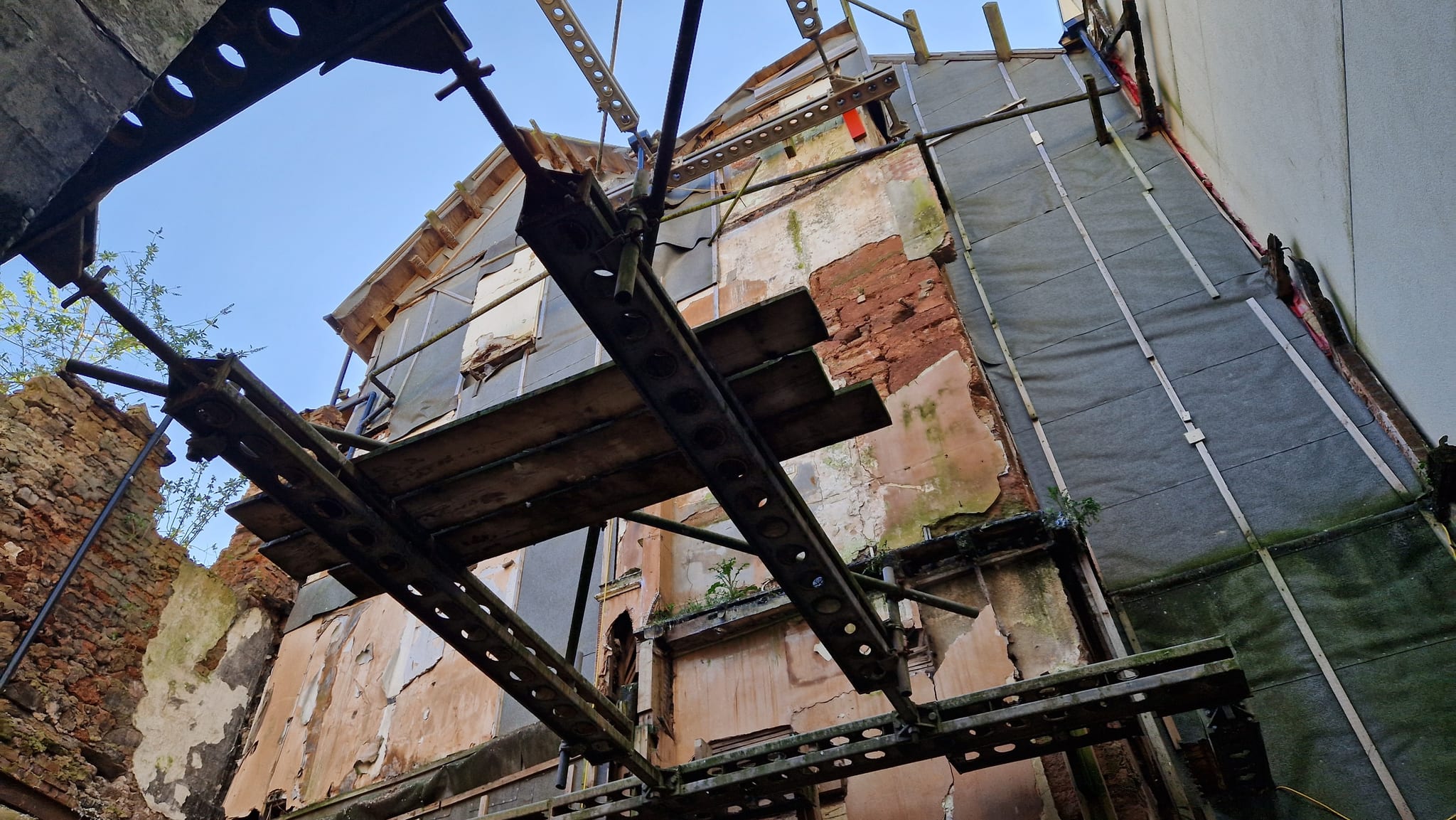
Tackling Exeter’s largest fire since the Second World War was understandably a huge pressure on Devon’s fire service. The blaze at the Royal Clarence Hotel in Exeter’s Cathedral Yard started 10 years ago on 28 October, and no fire in the city since has – thankfully – been bigger.
Firefighters were swift in their response, with the time of the call at 5:11:13am, and the first three appliances mobilised a little over a minute later at 5:12:33am.
First on the scene were Exeter Danes Castle at 5:18:49, and around 15 minutes later, 15 engines had been mobilised and five were on-scene by 05:40am, just before it was declared a major incident.
Ten engines were there by 5:50am, and the 20th fire engine had arrived by 6:35am.
Various challenges had to be overcome by the fire service, including its city centre location, near to other historic buildings, and the construction of the building itself which masked the scale of the incident as it unfolded.
Indeed, the fire actually began at a property referred to as No. 18, next door to the Royal Clarence, but spread to the interconnected buildings.
The gas supply had to be turned off by gas engineers, with one of the three locations for capping it off requiring concrete to be drilled through so it could be accessed and made safe.
“Our crews were at the scene for 10 days, with 95 appliances deployed over the course of the incident,” a spokesperson for Devon & Somerset Fire and Rescue Service said.
“In total, 1,186 firefighters attended, committing 12,094 operational hours. At the height of the response, 207 firefighters and 38 appliances were on site.
“It was an extremely challenging and dangerous incident involving fire that started in a renovated property and spread through hidden voids within the Royal Clarence Hotel.
“Thankfully, there were no injuries, and the fire was contained to the area of Cathedral Yard and did not spread to the surrounding high street.”
The spokesperson said the support shown by the people of Exeter throughout the incident was a “testament to the strength of the local community”.
The fire service produced a 50-page report on the fire, and states on its website that once inside the Royal Clarence, its firefighters “faced unsafe conditions after a wall collapsed and a firefighter nearly fell into the fire in the gallery next door”.
“The decision to swiftly withdraw crews due to unsafe conditions was correct,” it added.
“Our firefighters tackled a very difficult blaze that was unpredictable and risked spreading to the whole of the high street. Something we successfully prevented.”
But questions about the veracity of the report prompted the fire service to ask the National Fire Chiefs Council (NFCC) to peer review its findings.
This was, the fire service stated, to provide an independent view from people who understand operational tactics and reporting.
Experienced fire officers working on behalf of the NFCC reviewed the information collected by interviewing 21 people who either witnessed or were involved in the incident.
The fire service said accounts were checked against each other to build an accurate picture of what happened. They also asked to speak with a Sector Commander for the Royal Clarence area, who declined to be interviewed.
The NFCC acknowledges the fire service’s report provides a “representative timeline of events” but that the “absence of detail in the timeline of events up to 1018hrs [when the fire broke through the roof] has left an information vacuum which has been filled with many questions about the response to this incident and subsequently to the report itself”.
It also added its review team felt “confident” critical information had been disclosed to it which had not been disclosed during the fire service’s review.
It acknowledged it remained “speculative” as to whether the Royal Clarence could have been saved, or whether the command team was in receipt of a sector commander’s observations or not.
“However, the key findings of this review have revealed that whilst there may have been fire spread through undetected voids, the absence of a continual watching brief in all areas of the RCH following the withdrawal of personnel based on safety grounds does raise the possibility that there was detectable fire spread in the hotel which was not subsequently identified and necessary actions progressed,” the NFCC report states.
“Alongside this, there is evidence of an absence of a common recognised information picture at this incident, specifically in relation to what activities were taking place in and around the RCH and key information such as the declaration of a major incident, all of which will have impacted on the situational awareness of the command team.”
However, testimony from firefighters to the NFCC states that when crews were inside the hotel, they felt fire “above us, below us and all around us”, and that when one crew member placed their hand on a wall, it fell through to reveal fire.
Plus, some personnel stated the requirement for water, especially when aerial appliances were being brought in, appeared, at times, to overwhelm the water supply.
“This resulted in a delay in aerial appliances being brought into use and subsequently, the external attack on the fire,” the NFCC report states. The fire service acknowledges in its summary of events that a high volume pump was brought on scene to draw water directly from the River Exe, and that one pump on an appliance supplying an aerial platform took 20 minutes to be replaced after it failed.
There appears to be some uncertainty about whether the initial sector 4 commander passed on information he believed to be critical to the command team, or whether he did and that team ignored it.
But the NFCC states the area the commander was concerned about earlier on in the incident was not the area where the fire broke through the roof of the hotel at 10:18am.
And in a video on its website, the fire service states that the independent review “found there was no cover-up” and that the fire “most likely spread through hidden voids at the rear of the building”.
The fire service added the independent review “did find some new information but that information does not change the outcome of the incident”.
The fire service itself identified 81 learning points, according to the NFCC report, with more than a quarter (22) being related to policy and procedure and nearly a quarter (18) about the incident command system.
The NFCC said 12 learning points were still open as of November 2018, but that all had been closed when it re-approached the fire service in July 2019.
The fire service stated that people were “saddened by the loss of the Royal Clarence Hotel”, but were grateful the fire didn’t spread to other historical buildings.
“No-one was hurt as a result of the fire,” it added.
 'Please Mr Chancellor, help us keep Devon's young in Devon' say county leaders
 Exmouth Open Door to move to Town Hall
 French university and innovation leaders forge closer links with Exeter
 Finalists revealed for combatting violence against women and girls award
 Exeter community car club celebrates successful first six months
 A nightmare on Sewer Street: South West Water lifts the lid on the spooky items found inside its sewers
 Exeter College and GWR celebrate 10 years of apprenticeship success
 £24 million saved as Devon households throw away less waste
 Silent bid to support veterans suffering in silence
 Have a safe, considerate and greener Halloween
 RNLI crews spend nine hours searching Torbay seas during Storm Austen
 Public support sought to help Dawlish rat control measures succeed
 Global running competition comes to Riverside Leisure Centre
 Devon and Government prioritising support for young people
 Offenders help remove harmful waste from Devon beaches
 Dispute over rare bat‘s presence adds bite to Exmouth’s possible 700-homes site